

Basic Spanish phrases for travel
26 phrases · pronunciation · native-speaker audio
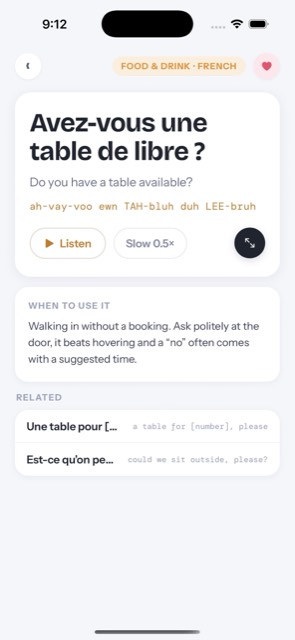
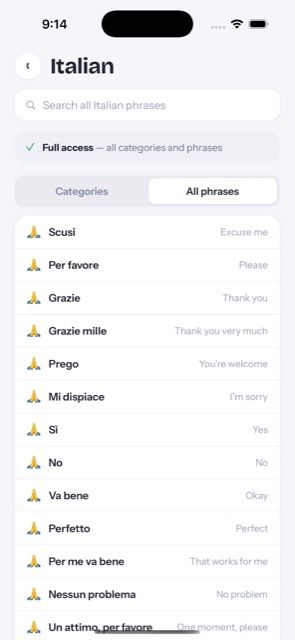
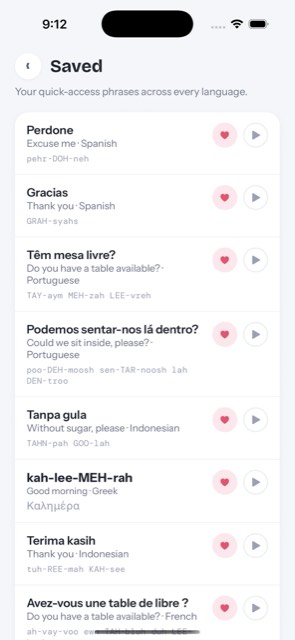
Heading to Spain and most of Latin America? These are the 26 phrases worth knowing before you land. The greetings and small courtesies that come up on day one, starting with “Hola”. Every one shows how it's written, how to say it, and has audio you can play.
These are free here and free in the app, in every language. Nothing to sign up for.
Essentials
-
Excuse me
Perdone
pehr-DOH-neh
The universal opener, great for getting a waiter’s attention, stopping a stranger for directions, or squeezing past someone on the metro. Lead with it and everything after goes smoother.
The polite way to catch a stranger’s attention. “Disculpe” works identically.
- Also common Disculpe dees-KOOL-peh
-
Please
Por favor
por fah-VOR
Attach it to almost any request. It softens everything, and locals notice when visitors use it.
-
Thank you
Gracias
GRAH-syahs
You can never say it too often. Use it for every small service such as handing over change, bringing a dish, giving directions.
-
Thank you very much
Muchas gracias
MOO-chahs GRAH-syahs
For when someone has gone out of their way and to show that extra bit of gratitude.
-
You’re welcome
De nada
deh NAH-dah
The universal response to thank you.
-
I’m sorry
Lo siento
loh SYEN-toh
For bumping into someone, knocking over a glass, or any small offence.
-
Yes
Sí
see
Everyone knows when to say yes, and being able to say it in the local language can be a really helpful way to navigate social interactions.
-
No
No
noh
Similar to yes, everyone knows when to use it and being able to say it in the local language can help across all sorts of situations.
-
Okay
Vale
BAH-leh
An all-purpose acknowledgement whether you’re confirming a price, a meeting point, a plan. Generally used the same way across languages.
“Vale” is the everyday okay in Spain, you’ll hear it constantly. In Latin America say “está bien”.
- Latin America Está bien ehs-TAH byen
-
Perfect
Perfecto
pehr-FEHK-toh
Warmer than a plain “okay”, and a great way to show you’re happy with a suggestion, a price, or a plan.
-
That works for me
Me parece bien
meh pah-REH-seh byen
Accepting a suggestion — a later table, a different room, an earlier train. Signals easy-going agreement.
-
No problem
No hay problema
noh eye proh-BLEH-mah
Reassuring someone who apologises, or waving off a small inconvenience. Keeps the mood light on both sides.
-
One moment, please
Un momento, por favor
oon moh-MEN-toh por fah-VOR
Buying yourself a few seconds when digging for your wallet, checking your phone, or holding a shop queue while you decide. Locals will be more patient when you can ask it in the local language
-
Could you help me, please?
¿Me puede ayudar, por favor?
meh PWEH-deh ah-yoo-DAR por fah-VOR
The polite way to open any request for assistance. Locals will be even more enthused to help when you ask it in their language.
Greetings
-
Hello
Hola
OH-lah
A must know in every language. A “hello” in the local language tends to get smiles, open doors, and has locals more eager to help.
-
Hi
Buenas
BWEH-nahs
The casual “hello” for friends, colleagues, and anyone you know well. A friendly opener that works in most situations.
The relaxed all-day greeting locals use walking into shops and bars — short for “buenas tardes/días”.
-
Good morning
Buenos días
BWEH-nohs DEE-ahs
Use it until around midday. A warm way to greet hotel staff, waiters and shopkeepers at the start of the day.
-
Good afternoon
Buenas tardes
BWEH-nahs TAR-dehs
For the stretch between lunch and sunset, in languages that use it. If you’re unsure of the cutoff, locals will forgive you either way.
Used from after lunch until roughly 8–9 pm — Spanish afternoons run late.
-
Good evening
Buenas noches
BWEH-nahs NOH-chehs
The greeting for later in the day — walking into a restaurant for dinner, or checking in after dark.
Doubles as “good night” — it greets and bids farewell after dark.
-
Goodbye
Adiós
ah-DYOHS
Leaving a shop, ending a chat, stepping out of a taxi. Locals will notice when you say it in their language, and it’s a nice way to close any encounter.
In practice locals often part with “hasta luego” even when they’ll never see you again.
- More casual Hasta luego AHS-tah LWEH-goh
-
See you later
Hasta luego
AHS-tah LWEH-goh
The friendly farewell for people you’ll cross paths with again such as hotel staff, your regular barista, new acquaintances.
-
Have a good day
¡Que tenga un buen día!
keh TEN-gah oon bwen DEE-ah
A warm sign-off after any small exchange. A great one to know in any language because locals will always appreciate it after an interaction.
-
My name is [name]
Me llamo [nombre]
meh YAH-moh [nombre]
It’s always useful being able to introduce yourself in the local language. A great way to build friends in your travels.
-
How are you?
¿Cómo está?
KOH-moh ehs-TAH
The polite version for strangers and staff. In a lot of countries it’s seen as a genuine question, so be ready for a real answer.
“¿Qué tal?” is the everyday version you’ll hear most — safe with almost anyone.
- Casual ¿Qué tal? keh TAHL
-
I’m well, thank you
Bien, gracias
byen GRAH-syahs
The standard reply to “How are you?”. Bounce the question back with a smile and you’ve just had your first conversation!
-
Nice to meet you
Encantado / Encantada
en-kahn-TAH-doh / en-kahn-TAH-dah
Always a great one to say when meeting someone new on your travels. Knowing it in the local language is a nice touch that locals will appreciate.
Ends in -o if you’re a man, -a if you’re a woman. “Mucho gusto” is a genderless alternative.
- Masculine Encantado en-kahn-TAH-doh
- Feminine Encantada en-kahn-TAH-dah
- Neutral Mucho gusto MOO-choh GOOS-toh
Also in the app
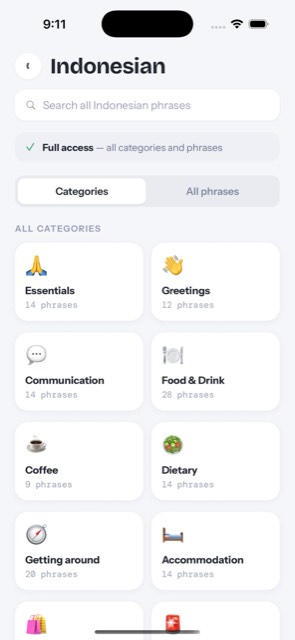
Nine more categories, 133 further Spanish phrases:
- Communication 14
- Food & Drink 28
- Coffee 9
- Dietary 14
- Getting around 20
- Accommodation 14
- Shopping 10
- Emergency 17
- Social 7